
Last updated September 30, 2026
Few houseplants put up with as much as the snake plant. Those stiff, sword-shaped leaves hold water like a cactus, it copes with dim rooms and dry winter air, and honestly it does better when you forget about it for a while. There’s just one thing it won’t forgive: soil that stays wet.
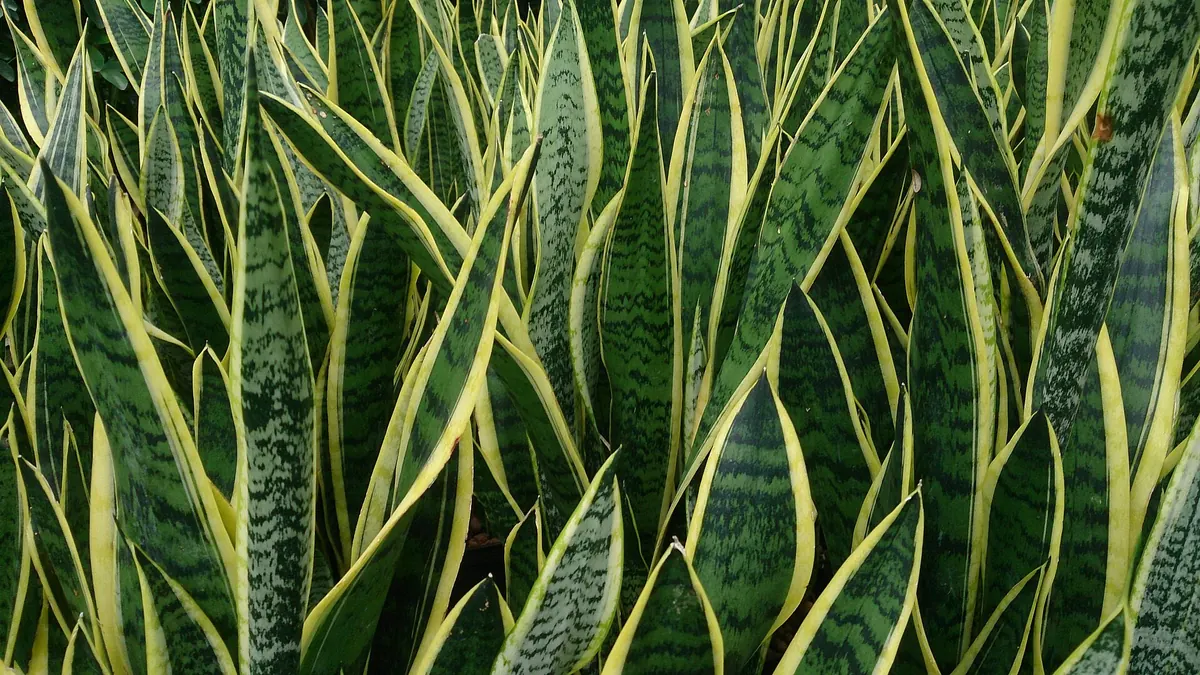
The quick answer: bright, indirect light (low light and a bit of direct sun are both fine), water only once the soil is dry all the way through, cactus mix in a pot with a drainage hole, keep it above 55°F, and feed it two or three times over spring and summer. That’s really it.

Meet the snake plant (and why it’s now a Dracaena)
If you know this plant as Sansevieria, you’re not wrong, just a few years out of date. After DNA studies showed how closely the two groups are related, botanists folded the whole genus into Dracaena in 2017–2018, so the official name is now Dracaena trifasciata. Most garden centers still use the old label. You’ll also hear it called mother-in-law’s tongue, Saint George’s sword or viper’s bowstring hemp, a nod to the tough leaf fibers once used for rope and bowstrings.
It comes from tropical West Africa, roughly Nigeria east to the Congo, where it grows in dry, rocky and often shady ground. The leaves are succulent, and the plant uses a water-saving form of photosynthesis called CAM, opening its pores mostly at night so it loses less moisture. In other words, it was built for drought.
| Variety | What it looks like | Typical height | Light note |
|---|---|---|---|
| ‘Laurentii’ | Gray-green bands, yellow edges | 3–4 ft | The classic; very adaptable |
| ‘Hahnii’ (bird’s nest) | Low, flat rosette | 6–8 in | Great for shelves |
| ‘Moonshine’ | Broad, pale silvery-green leaves | 2 ft | Needs brighter light to keep its color |
| ‘Black Coral’ | Very dark green, faint silver banding | 2–3 ft | Handles lower light well |
| ‘Futura Superba’ | Shorter, wider ‘Laurentii’ | 2 ft | Adaptable |
| Cylindrical (D. angolensis) | Round, spear-like leaves, often braided | 2–3 ft | Same care as the rest |
Snake plant care through the year
A snake plant’s needs change more with the seasons than with anything else, so here’s the whole routine laid out that way.
Spring
Growth wakes up. Water when the soil is fully dry, start feeding at half strength, and repot now if roots are crowding the pot or splitting it.
Summer
Peak growth. Expect to water about every 2–3 weeks in a bright, warm room. Feed once a month at most. It can go outside to a shaded patio.
Fall
Stop feeding. Stretch the gaps between waterings. Bring outdoor plants in before nights drop below 55°F.
Winter
Almost no growth. Water every 4–6 weeks, sometimes less in a cool house. Keep it off cold windowsills and away from drafts.
Light: from dim hallway to sunny sill
Yes, snake plants tolerate low light, and one will sit in a dark hallway for years. It just won’t do much there. Expect few or no new leaves, darker and floppier growth, and soil that takes ages to dry, which is exactly how rot starts.
For a plant that actually grows and holds its markings, give it bright, indirect light: near an east- or north-facing window, or a few feet back from a south- or west-facing one. Unlike a lot of houseplants, it can also take a few hours of direct sun, as long as you ease it in. Moving one straight from a dim corner to a hot window is how you get scorch marks.
- Not enough light: no new leaves, leaves leaning or flopping, variegated types fading.
- Too much sun, too fast: pale yellow or white patches, or dry brown scorch on the side facing the glass.
Watering without rotting the roots
Overwatering kills more snake plants than everything else combined. The roots and rhizomes rot fast in damp soil, and by the time you see the first sign, soft leaves collapsing at the base, the damage is usually done.
So water only when the soil is dry all the way through. Push a finger or a wooden skewer to the bottom of the pot; if anything damp clings to it, wait. In a warm, bright room that tends to mean every two to three weeks in spring and summer. In winter or low light it can stretch to every four to six weeks, and in a cool house even longer.
Underwatering is rarely fatal. A snake plant that’s gone too long simply looks thin and wrinkled, with leaves curling a little lengthwise. One good soak fixes it.
- Water the soil around the leaves until it runs out of the drainage hole.
- Let the pot drain completely.
- Empty the saucer. Never leave it standing in water.
Soil, pots and when to repot
Use a fast-draining cactus and succulent mix, or take regular potting mix and work in about a third perlite, pumice or coarse grit. Water should run straight through it.
A drainage hole isn’t optional. Terracotta suits snake plants particularly well: it breathes, dries quickly, and its weight stops a tall plant tipping over. Go only slightly wider than the root mass, and fairly shallow, since the roots spread sideways more than down.
Snake plants like being a bit crowded, so repotting every two to four years is plenty. Signs it’s time: roots growing out of the drainage hole, a pot that’s bulging or cracking (the roots really can split plastic and thin clay), or a plant so top-heavy it keeps falling over. Repot in spring, go up one size, and wait a week before watering.
Temperature, humidity and feeding
Normal indoor humidity is perfect, including dry winter air. No misting, no pebble trays.
Aim for roughly 60–85°F. Below about 50°F you risk cold damage, which shows up as soft, translucent, water-soaked patches on the leaves; frost kills leaves outright. Outdoors, snake plants are only hardy in about USDA zones 10 to 12.
As for food, less is more. A balanced liquid houseplant fertilizer, or a cactus fertilizer, at half strength about once a month in spring and summer is the upper limit. Two or three feeds a season works just as well. Overfeeding gives you brown tips, a salty crust on the soil and weak, floppy leaves.
Yes, snake plants bloom
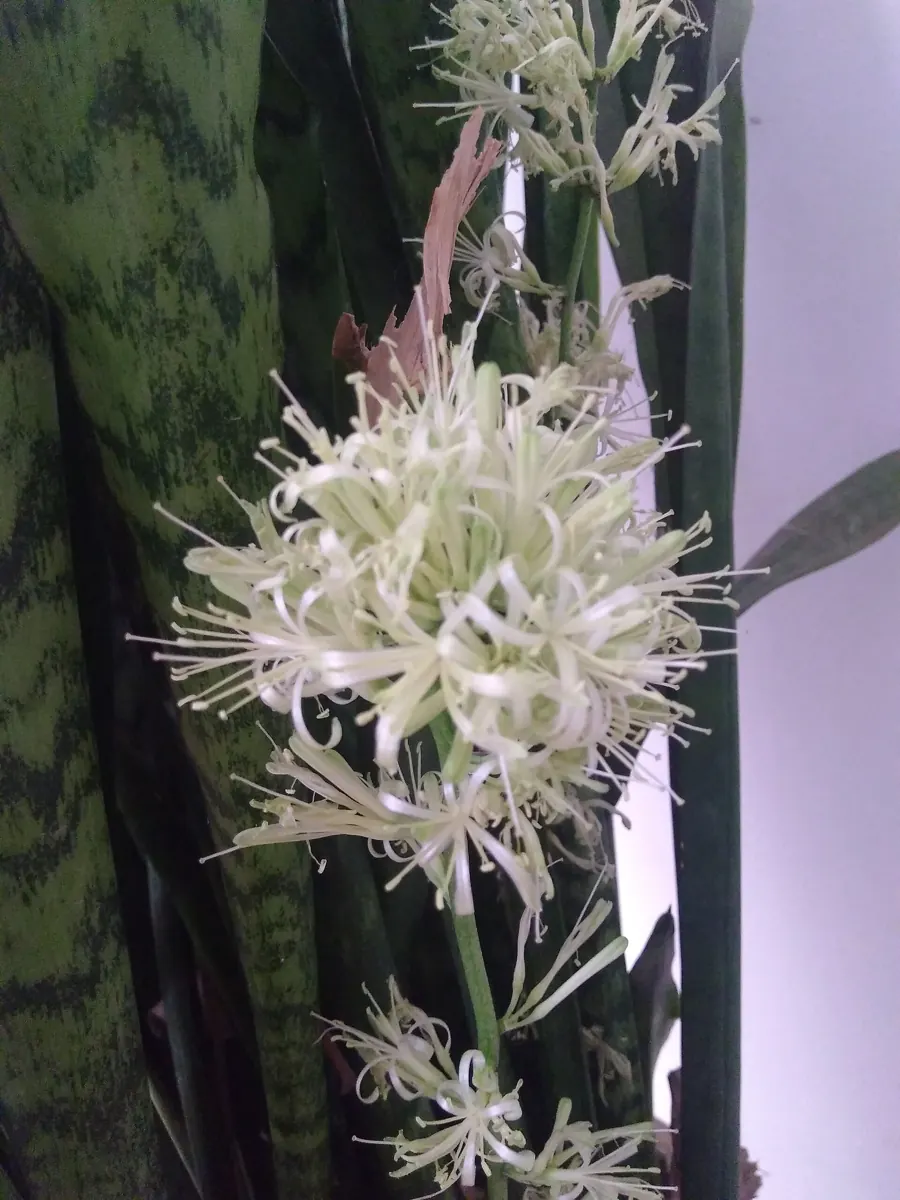
Mature, slightly pot-bound snake plants sometimes send up a tall stalk of fragrant, greenish-white tubular flowers. They often open in the evening and can drip sticky nectar. It’s a good sign, not a problem. The rosette that flowered won’t make any more leaves afterward, but the plant carries on through its pups. Snip the spent stalk off at the base.
Growth overall is slow: a few new leaves a year in good light, plus pups popping up from rhizomes around the edge of the pot. Most standard varieties top out at 2–4 feet indoors. One quirk: once a leaf’s tip is broken, that leaf stops growing taller, though the plant keeps making new ones.
Propagating: division vs leaf cuttings
Choose your method carefully here, because one of them won’t keep a variegated plant’s markings.
| Method | Reliability | Time to a new plant | Keeps variegation? |
|---|---|---|---|
| Division | Very high | Immediate | Yes |
| Separating pups | Very high | Immediate | Yes |
| Leaf cuttings | High but slow | Roots in 4–8 weeks; pups take months | No, yellow-edged types usually come back plain green |
Division and pups
In spring, unpot the plant and look for natural breaks: separate rosettes, or pups growing off the rhizome. Cut through the rhizome with a clean knife so each piece has its own roots, let the cuts dry for a day, and pot them in cactus mix. Wait a week before watering. It’s the only way to guarantee a ‘Laurentii’ or ‘Moonshine’ stays true to type.
Leaf cuttings, step by step
Cut the leaf into sections
Slice a healthy leaf into pieces 3–4 inches long. Mark which end was the bottom; upside-down cuttings won’t root.
Let the cuts callus
Leave the pieces to dry for a day or two until the cut ends feel sealed.
Root in water or soil
Stand them in an inch or two of water (change it weekly), or push the bottom end about an inch into barely moist cactus mix.
Wait for pups
Roots usually show within a month or two. New pups follow after that, sometimes several months later.
Troubleshooting common snake plant problems
Soft, mushy base; leaves collapsing
Root rot. Unpot, wash off the soil, and cut away every soft, brown or smelly root and leaf base back to firm, pale tissue. Let it dry a day, repot in fresh dry cactus mix, and skip watering for a week or two. If rot has taken most of the base, turn the healthy upper leaves into cuttings.
Leaves bending or falling over
Leaves that fold near the base and feel soft are usually overwatered. Firm leaves that splay outward are reaching for light. Bent leaves won’t straighten, so tie them loosely or use them as cuttings.
Brown, crispy tips
Usually cosmetic: long droughts followed by heavy watering, or salt buildup from fertilizer and hard tap water. Trim the brown part, following the leaf’s natural point, and water more evenly.
Wrinkled, thin or curling leaves
Thirst. Give it a thorough soak, then go back to watering whenever the soil dries out.
Yellow leaves
Almost always too much water. Let the soil dry completely and check the roots for rot.
Translucent, water-soaked spots
Cold damage. Move the plant away from cold windows and drafts; the marked leaves won’t recover but new growth will be fine.
Pests are uncommon. Watch for mealybugs hiding in the leaf bases and spider mites in hot, dry rooms (fine pale speckling). Wipe the leaves, dab mealybugs with rubbing alcohol on a cotton swab, and use insecticidal soap weekly for stubborn cases. Fungus gnats mean the soil is staying too wet.
Are snake plants toxic to cats and dogs?
Yes. The ASPCA lists the snake plant (under the name mother-in-law’s tongue) as toxic to both cats and dogs. It contains saponins, which can cause nausea, vomiting and diarrhea if eaten. Symptoms are usually mild to moderate, and the bitter taste tends to stop animals eating much, but keep it out of reach of plant-chewing pets and of young children who put things in their mouths.
If your pet eats part of one, call your veterinarian or the ASPCA Animal Poison Control Center at (888) 426-4435. For a child, call Poison Control at 1-800-222-1222.
Snake plant questions people ask
How often should you water a snake plant?
Only when the soil has dried out completely. For most homes that’s about every two to three weeks in spring and summer and every four to six weeks in winter, but check the soil first rather than following a calendar.
Can snake plants live in low light?
Yes, better than almost any houseplant. They’ll grow very little in a dim spot, though, and the soil stays wet longer, so water even less. For steady growth, give them bright, indirect light.
Why are my snake plant leaves falling over?
Usually overwatering, which softens the leaf bases and rots the roots. Check whether the soil is wet and the leaf bases feel mushy. Firm leaves that lean outward are more likely reaching for light.
Is a snake plant the same as a Sansevieria?
Yes. It was long known as Sansevieria trifasciata. Botanists moved the genus into Dracaena in 2017–2018, so its current name is Dracaena trifasciata. Both names mean the same plant.
How do I make my snake plant grow faster?
More light, warmth (70–85°F), a thorough watering whenever the soil dries out in spring and summer, and a light monthly feed in the growing season. Even at its best, though, a snake plant is a slow grower.
Sources and further reading
- ASPCA Animal Poison Control, Mother-in-law’s tongue
- Cummings and Waring (2019), Potted plants do not improve indoor air quality, Journal of Exposure Science and Environmental Epidemiology
- North Carolina State Extension, Dracaena trifasciata plant profile
More easy-care plants
If the snake plant suits you, the ZZ plant is its closest match for drought tolerance and low light, the spider plant is just as easy and safe around pets, and the rubber plant adds height to a bright corner. Or browse every guide in our houseplant care guides A–Z.
More from Houseplant Care
-
Money Tree Leaves Turning Yellow? 7 Causes and Fixes
Why money tree (Pachira aquatica) leaves turn yellow: overwatering, low light, drafts, sunburn, nutrients, pests or age, with a step-by-step check and fixes. -
Song of India Plant Care (Dracaena Reflexa)
Song of India (Dracaena reflexa) care: light, watering, humidity, brown tips from tap water, shaping twisty stems, propagation, problems and pet safety. -
China Doll Plant Care: Stop the Leaf Drop
China doll plant (Radermachera sinica) care: bright light, careful watering, why it drops leaves and how to stop it, pruning to keep it bushy, and pet safety. -
Dumb Cane Plant (Dieffenbachia) Care and Safety Guide
Dumb cane (dieffenbachia) care: light, watering, soil, cutting back a leggy cane, propagation, yellow leaves, and important safety tips for kids and pets. -
Monstera Plant Care: Bigger Leaves With More Holes
Monstera care: the light that makes split leaves, watering, soil, adding a moss pole, pruning and propagating from a node, yellow leaves and pet safety. -
Raven ZZ Plant Care: How to Keep It Black
Raven ZZ plant care: why new growth starts green and turns black, the light it needs to stay dark, watering, propagation, and how it differs from a ZZ.