
Last updated September 30, 2026
If you want an indoor tree but the fiddle-leaf fig’s reputation scares you, the rubber plant (Ficus elastica) is the one to get. Big, thick, glossy leaves in burgundy-black, classic green or pink-and-cream marble. A happy one can add a foot or more a year. What it asks for is simple: lots of bright light, steady watering, and not being shuffled around the house.
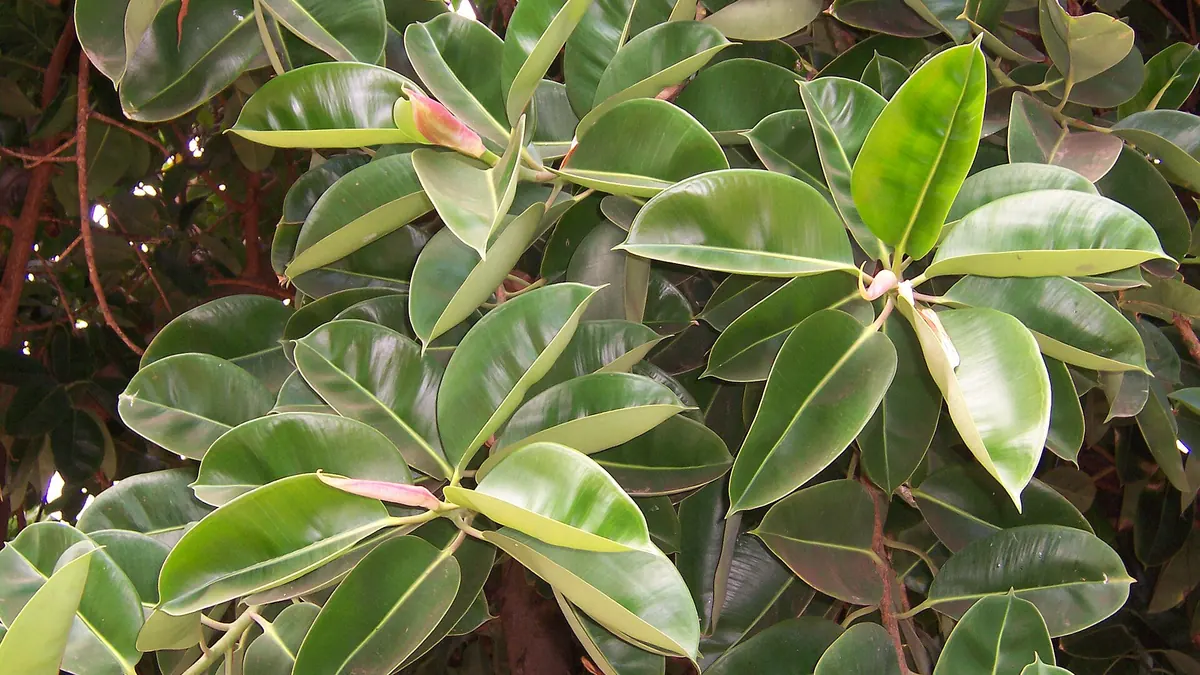
Rubber plant care in 30 seconds
- Bright, indirect light most of the day; a little gentle morning sun is fine.
- Water when the top 1–2 inches of soil are dry.
- Chunky, well-draining mix with bark and perlite, in a heavy pot with a drainage hole.
- 60–85°F, well away from cold drafts and vents.
- Half-strength feed monthly in spring and summer, and wipe the leaves now and then.

Choosing a rubber plant
All rubber plants need the same basic care, but the variety you pick changes how much light it needs. The paler the leaf, the brighter the spot.
‘Burgundy’ / ‘Black Prince’
Deep burgundy-black leaves with red sheaths on new growth. Copes with somewhat lower light than the variegated types. ‘Abidjan’ is similar.
‘Robusta’ / ‘Decora’
The classic: large, glossy, solid green leaves. Vigorous and forgiving.
‘Tineke’
Green marbled with cream and pale green, often with pink midribs. Needs bright light to keep its pattern.
‘Ruby’
Cream variegation with strong pink tones that deepen in bright light.
‘Shivereana’
A rarer form with pale green-yellow leaves speckled darker green.
One naming trap: the baby rubber plant (Peperomia obtusifolia) is a small, unrelated plant with a similar leaf shape, and jade plants sometimes get called “rubber plants” too. This guide is about Ficus elastica.
Where to put it: light by window direction
Light is the single biggest factor in how well a rubber plant grows. In a dim corner it stretches out long, bare stems with small leaves, leans hard toward the window, drops its lower leaves and uses water so slowly that overwatering becomes easy. Here’s where to put it:
| Window | Where to place the plant |
|---|---|
| East-facing | Right beside it. The gentle morning sun is ideal. |
| South-facing | A few feet back, or behind a sheer curtain. |
| West-facing | A few feet back; hot afternoon sun can scorch. |
| North-facing | Right up against the glass, and only for dark-leaved types. |
Harsh sun shows up as dry brown or bleached patches on the leaves facing the glass, usually after a sudden move into direct afternoon light. A plant that’s eased into brighter conditions over a few weeks can take more sun. Variegated types like ‘Tineke’ and ‘Ruby’ need the brightest light you can give without scorching, because their pale patches can’t photosynthesize. Give the pot a quarter turn every week or two so it grows straight.
Watering: consistent beats generous
Water when the top 1–2 inches of soil are dry. In a bright, warm room in spring and summer that’s often every week or two; in winter, every two to three weeks. Big pots stay moist longer, so check the soil rather than the calendar.
Rubber plants dislike both extremes. Soggy soil leads to yellow, dropping leaves and root rot. Bone-dry soil for long spells leads to drooping and curling leaves, which may then drop. Steady is what you’re after.
- Water slowly and evenly until it flows out of the drainage hole.
- Let the pot drain completely.
- Empty the saucer or cachepot after 15 minutes.
Soil, pots and repotting a tall plant
You want a mix that holds some moisture but drains freely and lets air reach the roots. Roughly two parts good indoor potting mix, one part orchid bark and one part perlite works well. Skip dense soils and garden soil.
Choose a heavy pot, ceramic or terracotta, with a drainage hole. A tall rubber plant in a light plastic pot tips over easily. Size up gradually; an oversized pot holds too much wet soil.
Young plants need repotting every one to two years in spring, when roots circle the pot or grow from the drainage hole. Go up about 2 inches. Rubber plants grow more slowly when slightly pot-bound, which is handy if you want to keep one smaller. For a plant that’s too big to repot comfortably, just scrape off the top 2–3 inches of soil each spring and replace it with fresh mix.
How to make a rubber plant bushier
Left alone, most rubber plants grow as one tall stem. If you’d rather have branches, prune it. The best time is spring or early summer, while it’s actively growing.
Prepare for the sap
Wear gloves and put a cloth down. The cut will ooze sticky white latex.
Choose your height
Decide where you want branches to start, and find a leaf node (where a leaf joins the stem) at that height.
Cut just above the node
Use clean, sharp pruners and cut straight across the main stem just above the node.
Stop the bleeding
Dab the cut gently with a damp paper towel until the latex stops flowing.
Within a few weeks, one or more new branches usually appear from the nodes just below the cut. Good light helps them develop. And the top you removed? That’s a cutting.
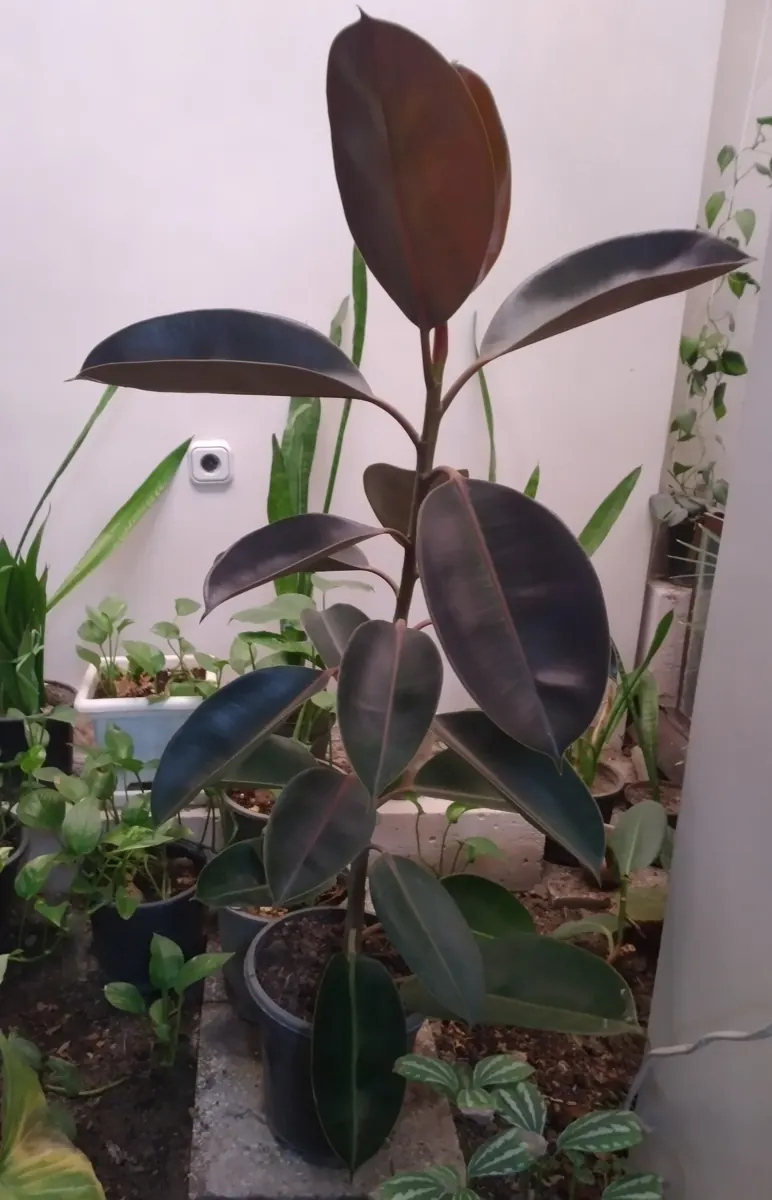
Keep the leaves clean
Those big leaves collect dust, and dust blocks light. Every few weeks, support each leaf from below and wipe it with a soft cloth dampened with plain water. Skip commercial leaf-shine sprays, which can clog the leaf surface.
Propagation: cuttings and air layering
| Method | Reliability | Time to roots | Best for |
|---|---|---|---|
| Stem tip cuttings in water | High | About 3–6 weeks | Using prunings |
| Stem tip cuttings in soil | High | About 4–8 weeks | Fewer transplant steps |
| Air layering | Very high | About 3–8 weeks | Tall, leggy plants |
| Single leaf with a node | Moderate | Several weeks | Several plants from one stem |
Stem cuttings
In spring or summer, take a 6–12 inch cutting from a stem tip with a few leaves and at least one node. Let the latex stop, rinse the cut end, and strip the lowest leaves so one or two nodes are bare. Stand it in room-temperature water with the bare nodes under the surface, or push it into moist, well-draining mix (rooting hormone helps here). Keep it warm, 70–80°F, in bright indirect light, change the water weekly, and pot it up once the roots are 1–2 inches long. Note that a single leaf without a node may grow roots but will never make a new shoot.
Air layering, step by step
This roots a section of stem while it’s still attached, and it’s the most reliable way to turn one leggy rubber plant into two good ones.
Wound the stem
Just below a node, make a shallow upward cut or remove a thin ring of bark.
Wrap in moss
Pack a handful of damp sphagnum moss around the wound.
Seal it
Wrap the moss in clear plastic and tie it at both ends.
Keep it moist
Check the moss every week or so and re-dampen it if it’s drying out.
Cut and pot
Once roots are clearly visible through the plastic, cut the stem below the moss ball and pot up your new plant.
Why is my rubber plant dropping leaves?
Like most figs, rubber plants react to change by dropping leaves. A plant that just came home from the store, moved rooms, or ended up near a cold window or a vent may shed a few as it adjusts. Pick a bright, stable spot, water consistently and give it a few weeks. If leaves keep falling, check the soil: soggy means overwatering, bone-dry means underwatering, and a dim corner means it needs more light.
Other rubber plant problems
| Symptom | Most likely cause | Fix |
|---|---|---|
| Yellow leaves, especially lower ones | Overwatering | Let the top 1–2 inches dry; check drainage and roots |
| Drooping leaves | Underwatering or root rot | Check soil moisture, then water or inspect roots |
| Curling leaves | Underwatering, dry air or cold | Water consistently; move away from vents and drafts |
| Brown, dry patches or edges | Sunburn, dry air or fertilizer buildup | Filter harsh sun; raise humidity; flush soil |
| Leggy growth, big gaps between leaves | Too little light | Move to brighter light; prune to branch |
| Variegation fading to green | Too little light | More bright, indirect light |
| Sticky leaves, brown bumps or webbing | Scale, mealybugs or spider mites | Wipe leaves; insecticidal soap or horticultural oil |
An occasional yellow lower leaf on an older plant is normal. If several yellow up and the soil smells sour, unpot the plant and look for dark, mushy roots; trim them off and repot in fresh mix.
Scale is the pest to watch for on rubber plants: small, immobile brown bumps on stems and under leaves, often with sticky residue. Scrape them off with a cotton swab dipped in rubbing alcohol, wipe the leaves, and treat with insecticidal soap or horticultural oil every week or two until they’re gone. Mealybugs and spider mites get the same treatment.
Temperature, humidity and feeding
Rubber plants handle dry indoor air better than many tropicals. Average humidity is fine, though leaves look their best at about 40–60%. Very dry air near heaters can brown the edges and invite spider mites.
Keep it between 60 and 85°F, and above all avoid cold drafts and sudden temperature swings, which are among the top causes of dropped leaves. Below about 50°F leaves can be damaged. Outdoors it survives year-round only in frost-free climates, roughly USDA zones 10 to 12.
Feed a balanced liquid fertilizer at half strength about once a month in spring and summer, and stop in fall and winter. A white crust on the soil or brown edges mean too much; flush the pot with plain water.
Where the rubber plant comes from
The rubber plant is a fig, native to a wide stretch of South and Southeast Asia, from northeastern India, Nepal and Bhutan through Myanmar and southern China to Malaysia and Indonesia. In the wild it becomes a huge rainforest tree, 100 feet or more, often starting life high in another tree and dropping aerial roots to the ground. Its milky latex was used to make rubber in the 1800s, before the unrelated Brazilian rubber tree (Hevea brasiliensis) took over.
Indoors it grows at a moderate to fast pace in good light, often 1–2 feet a year, with each new leaf unrolling from a colored sheath at the stem tip. Left unpruned it commonly reaches 6–10 feet over several years. It almost never flowers indoors; like all figs, its flowers are hidden inside small fruits and need a specific fig wasp to pollinate them.
Is a rubber plant toxic to cats and dogs?
Yes. The ASPCA lists the rubber plant as toxic to cats and dogs. The milky sap contains irritating compounds, and chewing or eating the leaves can cause mouth irritation, drooling, vomiting and diarrhea. Sap on the skin can irritate pets and people alike. Keep it away from plant-chewing pets and young children.
If your pet has eaten part of one, call your veterinarian or the ASPCA Animal Poison Control Center at (888) 426-4435. For a child, call Poison Control at 1-800-222-1222.
Rubber plant FAQs
How much light does a rubber plant need?
Bright, indirect light for most of the day, and it can take a little gentle direct sun. In low light it gets leggy, leans toward the window and drops lower leaves. Variegated varieties need the most light.
How often should I water a rubber plant?
When the top one to two inches of soil are dry, usually every one to two weeks in spring and summer and less often in winter. Water thoroughly, let it drain, and never leave it sitting in water.
How do I make my rubber plant bushier?
Prune the main stem just above a leaf node in spring or early summer. It will usually send out one or more branches from the nodes below the cut.
Is a rubber plant poisonous to cats?
Yes. The ASPCA lists it as toxic to cats and dogs. The milky sap can irritate the mouth and stomach, causing drooling, vomiting and diarrhea.
How big does a rubber plant get indoors?
Commonly 6 to 10 feet over several years if left unpruned. Pruning the top and keeping it in a slightly snug pot keeps it much smaller.
Sources and further reading
- ASPCA Animal Poison Control, Indian rubber plant
- North Carolina State Extension, Ficus elastica plant profile
- Wikipedia, Ficus elastica
Other statement plants
Want more drama? The bird of paradise brings huge tropical leaves to a sunny room. For spots with less light, the ZZ plant and snake plant are two easy, upright choices. Or browse all our houseplant care guides.
More from Houseplant Care
-
Money Tree Leaves Turning Yellow? 7 Causes and Fixes
Why money tree (Pachira aquatica) leaves turn yellow: overwatering, low light, drafts, sunburn, nutrients, pests or age, with a step-by-step check and fixes. -
Song of India Plant Care (Dracaena Reflexa)
Song of India (Dracaena reflexa) care: light, watering, humidity, brown tips from tap water, shaping twisty stems, propagation, problems and pet safety. -
China Doll Plant Care: Stop the Leaf Drop
China doll plant (Radermachera sinica) care: bright light, careful watering, why it drops leaves and how to stop it, pruning to keep it bushy, and pet safety. -
Dumb Cane Plant (Dieffenbachia) Care and Safety Guide
Dumb cane (dieffenbachia) care: light, watering, soil, cutting back a leggy cane, propagation, yellow leaves, and important safety tips for kids and pets. -
Monstera Plant Care: Bigger Leaves With More Holes
Monstera care: the light that makes split leaves, watering, soil, adding a moss pole, pruning and propagating from a node, yellow leaves and pet safety. -
Raven ZZ Plant Care: How to Keep It Black
Raven ZZ plant care: why new growth starts green and turns black, the light it needs to stay dark, watering, propagation, and how it differs from a ZZ.